螺旋星云中奇特的彗星结
(原标题: Curious Cometary Knots in the Helix Nebula)
2026-08-04
浏览次数: 1733
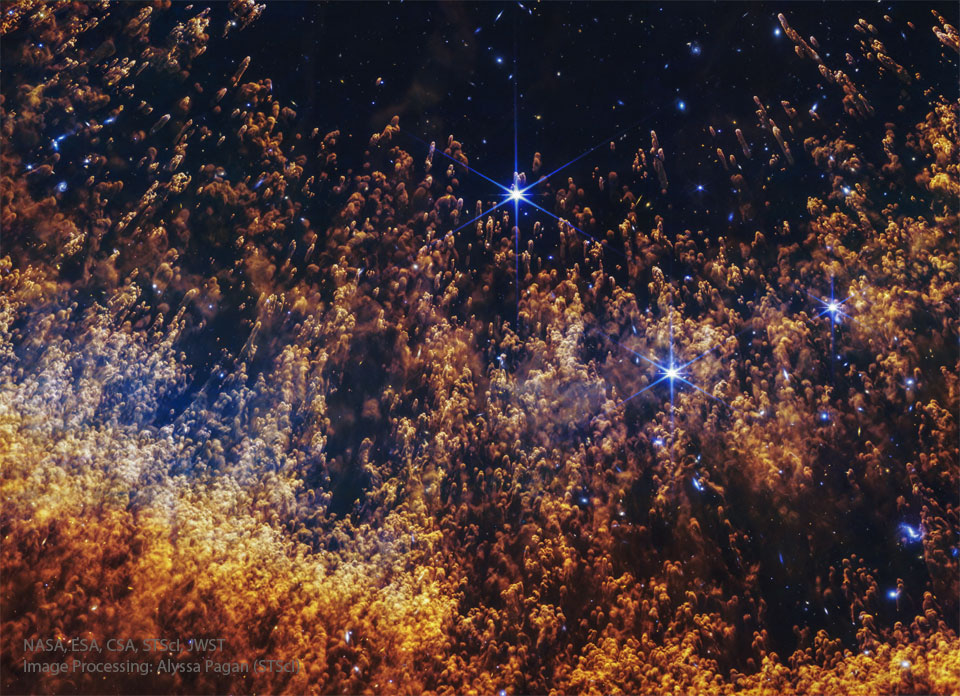
是什么导致了行星状星云中不寻常的气体和尘埃结?在环状星云、哑铃星云和NGC 2392中也可以看到这些结,它们的存在最初并没有被预测到,它们的起源也没有被很好地理解。这是一张由詹姆斯·韦伯太空望远镜拍摄的螺旋星云部分迷人的照片,在红外光下显示了惊人的细节。彗星结的质量与地球相似,但其大小通常是冥王星轨道的几倍。一种关于星团分裂和演化的假说认为,现有的气体是由中心演化恒星的密度较低但能量较高的恒星风吹出的。螺旋星云是在类太阳恒星生命结束时形成的行星状星云的最接近的例子之一。螺旋星云的技术名称是NGC 7293,它位于650光年外的水瓶座。开放科学:浏览天体物理源代码库中的4000多个代码
查看原文解释
What causes unusual knots of gas and dust in planetary nebulas? Seen also in the Ring Nebula, the Dumbbell Nebula and NGC 2392, the knots' existence was not initially predicted, and their origins are still not well understood. Pictured here is a fascinating image of part of the Helix Nebula by the James Webb Space Telescope showing tremendous detail in infrared light. The cometary knots have masses similar to the Earth but have sizes typically several times the orbit of Pluto. One hypothesis for the fragmentation and evolution of the knots includes existing gas being driven out by a less dense but highly energetic stellar wind of the central evolving star. The Helix Nebula is one of the closest examples of a planetary nebula created at the end of the life of a Sun-like star. Given a technical designation of NGC 7293, the Helix Nebula lies about 650 light-years away towards the constellation of Water Carrier (Aquarius). Open Science: Browse 4,000+ codes in the Astrophysics Source Code Library