Longmore 8:仓鼠轮星云
(原标题: Longmore 8: The Hamster Wheel Nebula)
2026-06-17
浏览次数: 1729
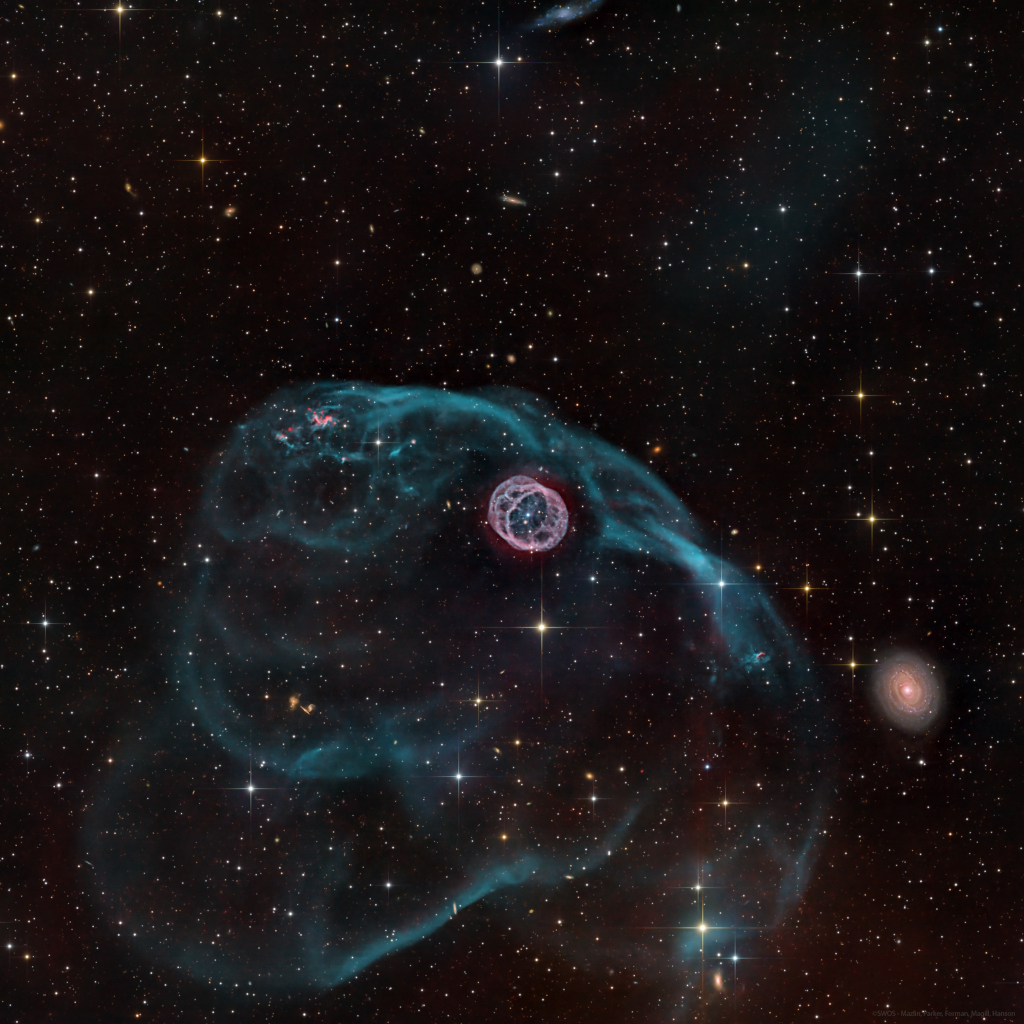
仓鼠轮是怎么进入太空的?仓鼠轮星云(Longmore 8)是安德鲁·朗莫尔在1976年发现的,是对南部天空进行大规模调查的一部分。这次调查采用了几项摄影技术的改进,包括使用高灵敏度的胶片,在底片上捕捉更深和更暗的物体,用眼睛检查并编目。这张特色图片是在智利的El Sauce天文台拍摄的,描绘了一个复杂的车轮结构,发光的氢被一颗垂死的恒星抛到太空中,被剩余的白矮星电离。这个结构在原来的底片上几乎看不见,强调了现代望远镜和照相机的力量。两个相对的红色氢气团包裹在电离氧的蓝色面纱中,暗示着在轮子中心明亮的白矮星的伴星的存在!
查看原文解释
How did a hamster wheel get into space? The Hamster Wheel Nebula (Longmore 8) was discovered by Andrew Longmore in 1976 as a part of a larger survey of the southern sky. This survey employed several improvements in photographic technology, including the use of highly sensitive film, to capture deeper and fainter objects on plates that were examined by eye and catalogued. The featured image, taken at Observatorio El Sauce in Chile, depicts an intricate wheel structure of glowing hydrogen that was thrown out into space by a dying star and ionized by the leftover white dwarf. This structure was barely visible on the original plate, emphasizing the power of modern telescopes and cameras. Two opposing clumps of red hydrogen gas encased in the blue veil of ionized oxygen hint at the presence of a companion to the bright white dwarf at the wheel’s center!
© Mazlin, Parker, Forman, Magill, Hanson Text: Keighley Rockcliffe (NASA GSFC, UMBC CSST, CRESST II)