金星和木星:从埃夫伯里相合
(原标题: Venus and Jupiter: Conjunction from Avebury)
2026-06-12
浏览次数: 1806
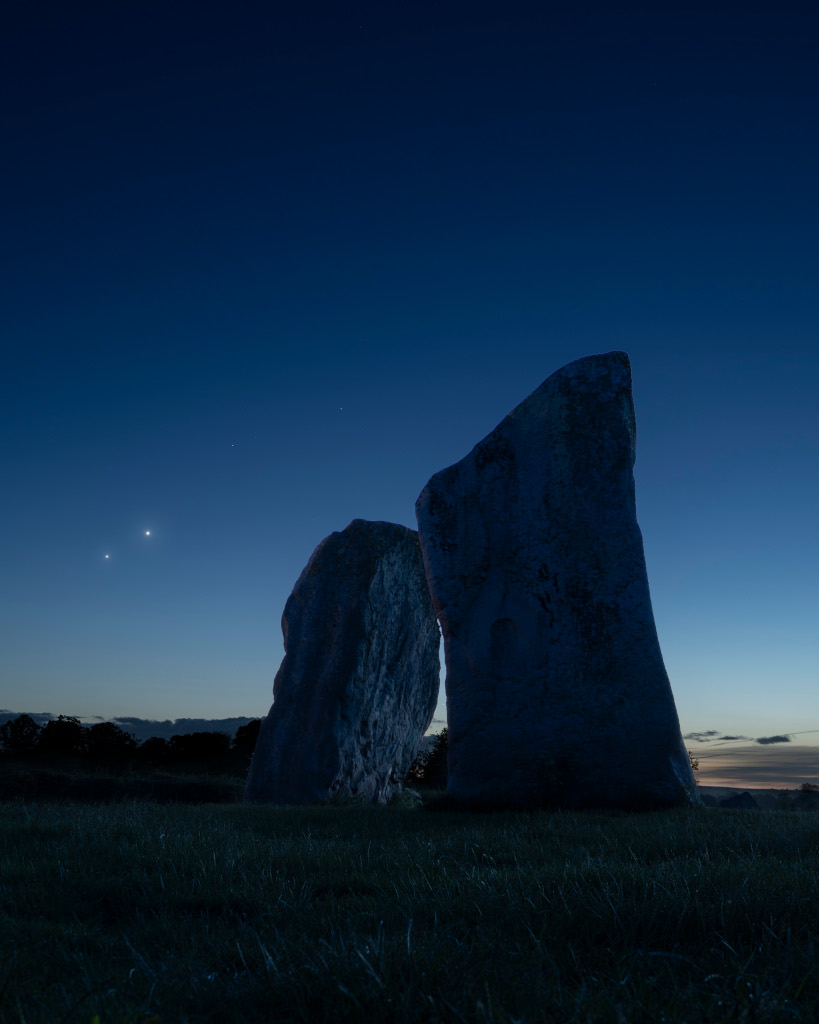
这个月要看到金星和木星在一起,你不需要双筒望远镜,甚至不需要望远镜。只要在日落之后抬头看,你就会发现它们出现在西方地平线附近的天空变暗。事实上,在6月9日,这两颗最亮的行星紧密相合,从我们的角度来看,它们在天空中相隔不到2度。由于(更亮的)内行星金星绕太阳运行的速度比外行星木星快,所以它大约每13个月就会沿着黄道赶上并经过外行星。但每隔三年左右,它们的合相就可以在离太阳足够远的地方被观察到,在地球黄昏的天空中很容易被看到。6月9日,在英国埃夫伯里一个有4000年历史的石圈内,两个天体灯塔在海湾的两个巨大的站立石头旁边紧密地“宇宙之吻”被捕捉到。埃夫伯里石阵和石圈建筑群比巨石阵更大,也被认为是地球上最重要的新石器时代仪式场所之一。
查看原文解释
To see Venus and Jupiter together this month, you won't need binoculars or even a telescope. Just look up after sunset and you'll find them emerging as the sky grows dark near the western horizon. In fact, on June 9 the two brightest planets were in close conjunction, separated on the sky by less than 2 degrees from our perspective. Since (brighter) inner planet Venus orbits the Sun faster than outer planet Jupiter, it catches up with and passes the outer planet along the ecliptic roughly every 13 months. But every three years or so their resulting conjunction can be viewed far enough from the Sun to be easily seen in Earth's twilight skies. On June 9, the two celestial beacon's close "cosmic kiss" was captured here next to the two large standing stones at the cove within a 4,000 year old stone circle at Avebury, UK. Larger than Stonehenge, the Avebury henge and stone circle complex is also recognized as one of the most significant neolithic ceremonial sites on planet Earth.
© Josh Dury