泰德天文台的春分
(原标题: Spring Equinox at Teide Observatory)
2026-03-20
浏览次数: 1968
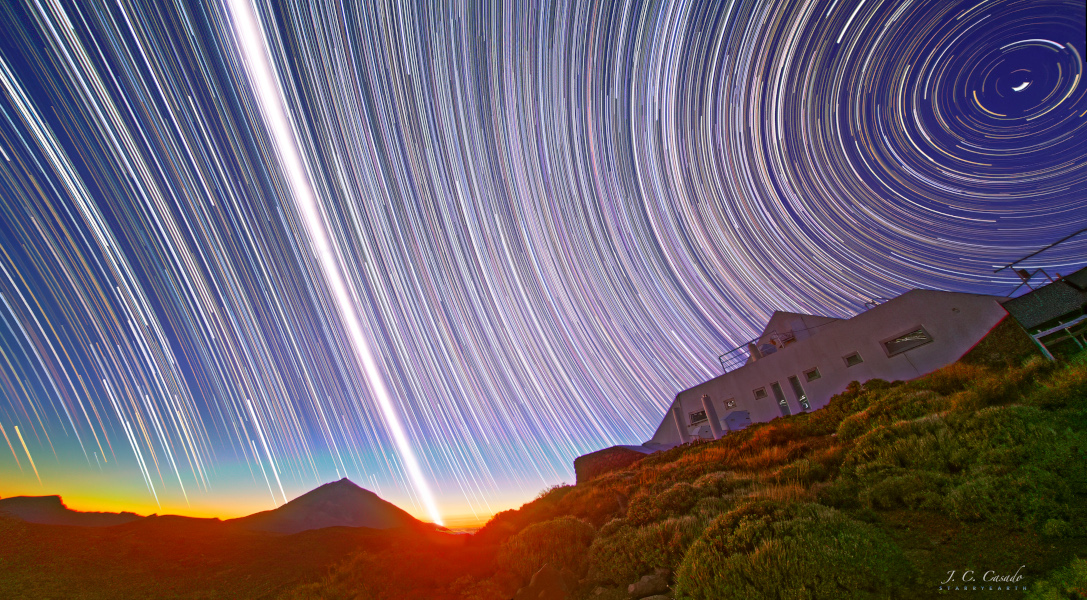
今天春分的决定性天文时刻是在14:46 UTC(3月20日)。这是当太阳在每年一次的穿越地球天空的旅程中穿过向北移动的天球赤道时,标志着我们美丽的星球北半球春天的开始和南半球秋天的开始。那时,全球的白天和黑夜几乎是相等的。事实上,在西班牙加那利群岛特内里费岛的泰德天文台,春分的白天和夜间曝光都被用于这幅合成的天景中。他们用鱼眼镜头拍摄了1000多张照片,并将其合并到这个雄心勃勃的春分项目中。在春分日,太阳沿着天球赤道的明显运动遵循明亮的线性,对角线轨迹,这是白天拍摄的超过6小时的曝光序列。日落后,夜间曝光记录星迹,天球赤道是一条直线轨迹,同心弧环绕着右上方靠近北极星的北天极和左下方边缘以外的南天极(在泰德地平线以下)。前景包括遥远的泰德火山高峰和天文台金字塔形的太阳实验室建筑。
查看原文解释
The defining astronomical moment of the equinox today is at 14:46 UTC (March 20). That's when the Sun crosses the celestial equator moving north in its yearly journey through planet Earth's sky, marking the beginning of spring for our fair planet in the northern hemisphere and fall in the southern hemisphere. Then, day and night are nearly equal around the globe. In fact, both day and nighttime exposures from a spring equinox at the Observatorio del Teide in Tenerife, Canary Islands, Spain, are used in this composited skyscape. Over 1,000 images were taken with a fisheye lens and merged in the ambitious equinox project. The apparent motion of the Sun setting along the celestial equator on the equinox date follows the bright linear, diagonal track from the sequence of daytime exposures taken over 6 hours. After sunset, nighttime exposures recorded startrails, with the celestial equator as a linear track and concentric arcs circling the north celestial pole near Polaris at upper right and the south celestial pole beyond the lower left edge (and below the Teide horizon). The foreground includes the distant Teide volcano peak and the observatory's pyramid-shaped solar laboratory building.
© Juan Carlos Casado